Evonik: Improving gut health and performance of weaned pigs by using a Bacillus subtilis based probiotic - Gutplus®
Balachandar Jayaraman1, John K. Htoo2 and Girish Channarayapatna1
1Evonik Methionine (SEA) Pte., Ltd. Singapore, 2Evonik Operations GmbH, Hanau-Wolfgang, Germany.
Post-weaning diarrhea (PWD) is one of the critical challenges in nursery pigs which is frequently caused by enterotoxigenic E. coli K88 (F4) and E. coli F18. Usage of in-feed antimicrobial growth promoter (AGP) and zinc oxide (ZnO) have been effective to control PWD. However, due to the development of antimicrobial resistance in humans, there is a need for alternatives to AGP and ZnO. Probiotics is one of the functional feed additives commonly used to improve gut health and production performance in pigs. Bacillus subtilis DSM 32540 (GutPlus®) is a probiotic particularly developed for swine application by Evonik through a multi-parameter selection process based on its ability to produce secondary metabolites, lactic acid and to inhibit pathogens including E. coli and Streptococcus suis while compatible with organic acids and AGP in the feed. Recent studies demonstrated that this strain showed beneficial effects on gut barrier, performance, and profitability in weaned pigs.
A 21-day trial evaluated the effects of supplementation with GutPlus® or AGP in weaned pigs challenged with E. coli K88 (Park et al., 2020). In this study, 21 pigs were fed one of the 3 dietary treatments: 1) Negative control - corn-soybean meal-based nutrient adequate mash diet without any feed additives (NC), 2) NC plus 0.25% antibiotics (neomycin and oxytetracycline), or 3) NC plus 0.05% GutPlus® (1.0 x10⁶ CFU/g of feed). All pigs were orally challenged with a subclinical dose (6.7 × 10⁸ CFU/mL) of E. coli K88 on day 3 of the study (3 day post-weaning).
Growth performance of weaned pigs during E. coli K88 challenge (18 days) are presented in Figure 1. There was an increase in gain:feed with AGP and GutPlus® treatment compared to the NC group, while no difference between AGP and GutPlus® was observed. Two out of 7 pigs receiving the NC diets died on day 1 and 2 after the challenge as a consequence of the E. coli infection while pigs fed AGP and GutPlus® had no mortality. These improved feed efficiency and survival rate of pigs fed GutPlus® were due to enhanced gut morphology (barrier function) associated with lower diarrhea rate.
Optimal gut morphology is essential not only for biological functions such as digestion and absorption but also for protecting the pigs from harmful pathogens. The most commonly measured gut morphological parameters are villus height (VH), crypt depth (CD) and villus height to crypt depth ratio (VH:CD ratio). Increased VH may result in a greater absorptive capability for available nutrients, whereas reduced CD indicates a decrease in metabolic cost of epithelium turnover. In this study, pigs fed diets supplemented with GutPlus® had the greatest (P<0.001) VH and (VH:CD) among treatments on day 18 (Figure 2). No difference was observed on CD among treatments. In ileum, no effects of treatments were observed in CD or VH:CD, but GutPlus® tended ( P= 0.095) to increase VH at greater extent than AGP compared to NC pigs.
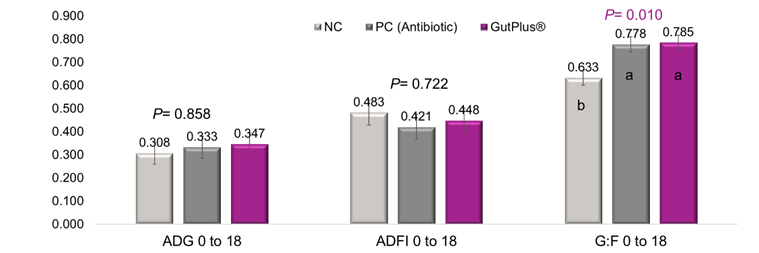
Figure 1: Effects of dietary inclusion of antibiotic or probiotic (GutPlus®) on performance of piglets under E. coli K88 challenge
Results of the same study showed that increased fecal score after the oral inoculation of E. coli on day 0, and gradually reduced until d 12 to the same lowest fecal score observed before the challenge. Pigs that were fed diets supplemented with AGP or GutPlus® tended (P = 0.071) to reduce the frequency of diarrhea (scores 3 to 6) compared to pigs fed NC diets.
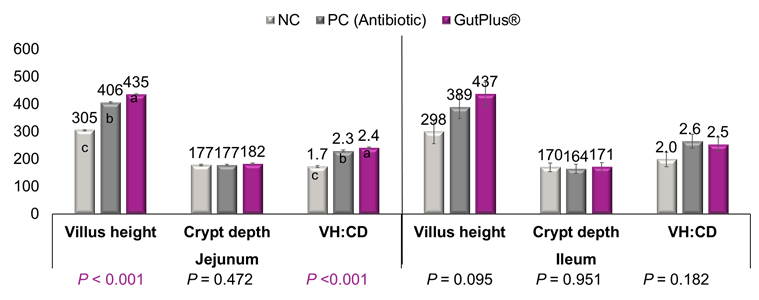
Figure 2: Piglets with GutPlus® had greater villus height and VH:CD ratio than pigs fed NC and PC (antibiotics) diets in jejunum on day 18
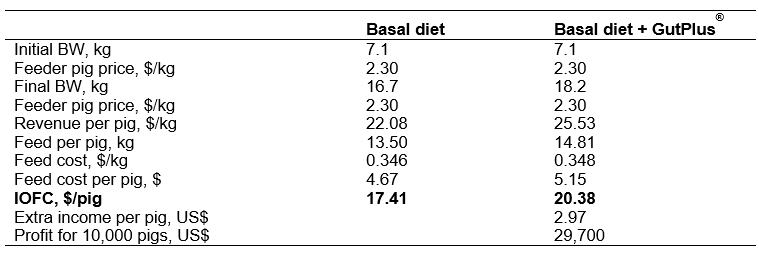
Another study conducted in Spain under normal production conditions (Facts and Figures 14155) demonstrated that Gutplus® supplementation increased final body weight and ADG of weaned pigs. Piglets fed Gutplus® had reduced pathogenic bacteria (Escherichia) and increased beneficial bacteria (Ruminococcaceae) indicating that Gutplus® can improve gut microbiota balance. An economical assessment was estimated (Table 1). As shown in Table 1, dietary supplementation with Gutplus® increases income over feed cost (2.97 US$/pig) and the overall profitability in pigs
Table 1. Economic analysis of Gutplus® supplementation in diets for weaned pigs