
December 15, 2025
Turkey developing technologies to drive yields on livestock farming with limited resource use, official says
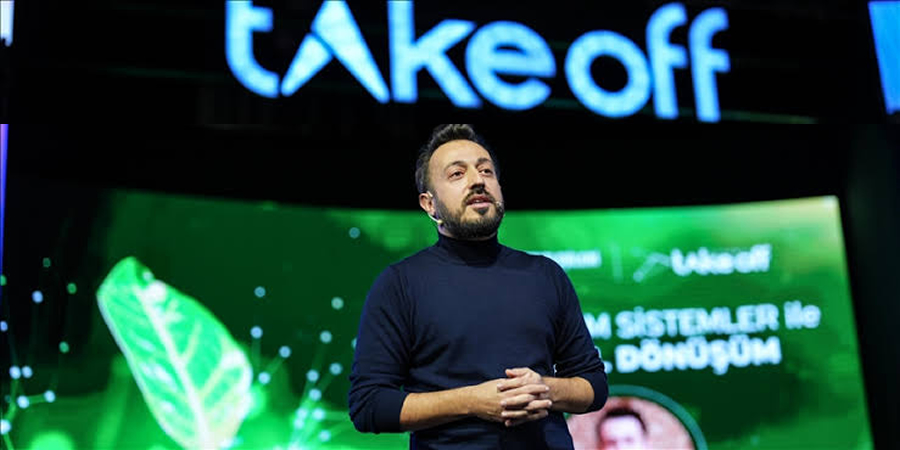
Achieving high yields with limited resource use in agriculture and livestock farming is one of humanity's fundamental needs, the head of Turkey's Agricultural Technologies Cluster (TUME), Abdulkadir Karagoz, said on December 11, adding that the country's own engineers are developing these technologies indigenously.
Speaking at the Take Off Turkey Startup Summit, Karagoz stressed that Turkey's journey over the last decade, which has developed capabilities in engineering, self-confidence, and human resources through the National Technology Move, is now beginning to have an impact on civilian technologies.
The two-day summit, which began on December 10 and featured Anadolu as its global communications partner, was held at the Istanbul Expo Center by the Turkish Technology Team Foundation (T3 Foundation), the Industry and Technology Ministry, and the Investment and Finance Office.
"When you don't produce defense or agricultural technologies, your dependency grows instead of your capabilities," he said, noting that, therefore, Turkey has been developing its technological capabilities over the past 10 years and has now reached the stage of expanding this into other areas.
"We have launched a section on agricultural technologies at TEKNOFEST (Turkey's major technology event) this year, and we invited our partners, various universities, and start-ups," he pointed out. These technologies are now being developed indigenously in Turkey with local sources by Turkish people, he said, adding: "We are actually trying to bring together those who develop this technology under one cluster."
Regarding new technologies in agriculture and livestock fields in Turkey, he said that many farms across the country are now using autonomous technologies for a variety of tasks, such as monitoring or milking cows, and productivity is significantly increasing.
Karagoz went on to say that TUME is now looking for thousands of young people who want to work in agricultural and livestock production using new technologies, and that the organisation will help them by training them and finding financial resources, such as investors.
Looking back 75 years, the world has seen an incredible increase in milk and meat production and agricultural output, he said, noting that this surge has been even more positive in Turkey than in the rest of the world, particularly in the last 20 years; in other words, Turkey has tripled its agricultural output in the last 25 years.
"Twenty-five years ago, our overall exports were around $35 billion, and today, we have reached a level where we export $35 billion in agriculture alone," he said.
Karagoz underscored that Turkey is a massive agricultural country with a large production economy. "So, if we produce so much and are so self-sufficient, what's the problem? We feed ourselves and the rest of the world, but we're having trouble keeping prices stable."
The second major issue, which occasionally troubles both producers and consumers, he explained, is a game-changing one: sustainability.
"Production is increasing due to increased consumption. Global demand is increasing. Worldwide, including in Turkey," Karagoz stated.
"However, production pressure creates sustainability issues. I'm not only talking about Turkey. I'm talking about the whole world, but let's focus on Turkey specifically. Today, our water resources are decreasing. Our soil resources are depleting and becoming polluted. Pollution is increasing. And epidemics are escalating."
He added that Turkey, as a major manufacturing country, is facing the same challenges as the rest of the world, including the climate crisis, fragile supply chains, and geopolitical risks.
He recalled how ships that had been sailing around the world for decades were unable to move during the pandemic, and supermarket shelves were empty all over the world.
He noted: "We are facing geopolitical risks. Unfortunately, food is being used as a weapon today. When there was a war between Ukraine and Russia, we talked about the grain crisis. We talked about urea, which rose from $200 to $1,200 per tonne.
"And unfortunately, we saw food being used as a weapon in Gaza. We saw people being left to starve by Israel. These are things we would have said would never happen in the tens of thousands of years of human history. But in the last 30 years of our lives, we have seen these things in the world."
In addition to the climate crisis, water problems, supply chain issues, and geopolitical risks, there is sociological transformation, he said, noting that the average age of the population engaged in agriculture and livestock is around 60 in Turkey; people do not want to work in these fields.
Stressing that importing goods from other countries is not reliable, he said: "We just talked about supply shocks. One day, a tweet may come, and the Strait of Gibraltar may close, just like the Suez Canal. We need to become self-sufficient. We need to ensure food supply security and price stability. and the solution is technology."
"If we don't drive cars from 25 years ago, if we don't even use phones from a year ago, why are we using technology from 50 years ago in agriculture and livestock farming?" he asked.
He said Turkey's milk consumption and production are around 20 million tonnes, so it is a self-sufficient country in milk. However, the country produces 20 million tonnes with 10 million cows, yielding 2,000 liters of milk per cow.
"Sociologically, the number of producers is decreasing," Karagoz said. "Where we have constraints on water resources, what model should we replace it with? We need to replace it with genetics, we need to replace it with embryo transfer, we need to replace it with autonomous models, and we need to achieve a milk yield of 10 tonnes per cow.
"This means that the milk produced by 10 million animals will be produced by two million animals," he said.
- Anadolu Agency