
November 21, 2010
Latin American beef: Feedlots, grassland & the question of beef marketing
Thanks to an abundance of natural resources and much official encouragement, South American beef exports now rival those of English-speaking countries. While Brazil's future seems bright, Argentina is caught between a cost-driven feedlot cattle raising model and misguided government intervention.
An eFeedLink Hot Topic
by Eric J. BROOKS
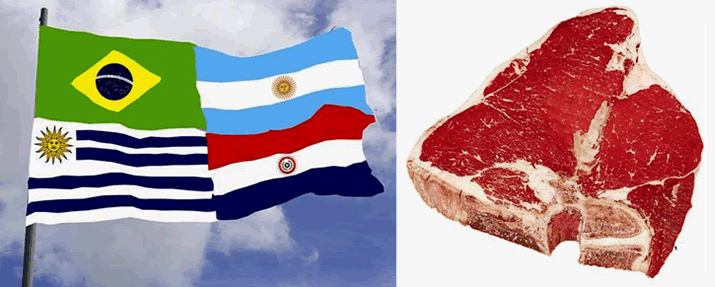
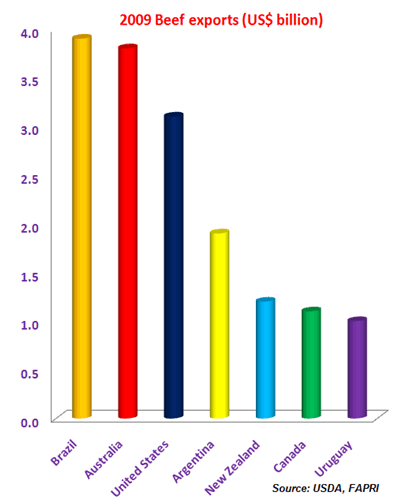 With Brazil at the forefront and Argentina and Uruguay adding further momentum, Latin America has assumed pride of place in world beef exports. At US$6.8 billion, Brazil, Argentina and Uruguay's 2009 combined beef exports roughly equal those of the United States and Australia. Yet, Brazil is increasingly stealing the show and South America's junior beef exporters will have to learn the art of niche marketing.
Abundant feed, low costs, power Brazilian exports
It has been a relatively rapid metamorphosis. Brazil only crossed the US$1 billion in beef exports in 2000. By 2004, it was ranked number three to top ranked United States and Australia. By 2007, it overtook Australia to lead with US$4.4 billion of exports. At the top of the pre-recession economic cycle in 2008, Brazilian beef was valued at over US$5 billion. This meant that from 2000 to 2008, the value of its beef exports jumped at a cumulative annual growth rate of 22.5% per year. According to the USDA, it currently accounts for approximately 25% of global beef exports.
Mind you, fortune was smiling on Brazil in more ways than one at this time. As outlined in our previous article on American beef, Brazilian cattle remain less productive than their American counterparts, which still produce more meat from half the number of animals. This was counterbalanced by Brazil's low labour costs, plentiful feed grain supplies and productivity that jumped by 50% between 1990 and 2010. Other factors in the country's favour included large, expandable cattle grazing area, plentiful, subsidized feed and a currency which was significantly undervalued at that time. When the world's leading beef exporter was barred from exporting by mad cow disease, these factors coincided to create an explosion of Brazilian beef exports.
Moreover, unlike other Latin American beef producers, Brazil, like its American competitor, enjoys a large domestic market of 200 million. With domestic consumption accounting for 80% of its production, it is the third largest beef market after the United States and European Union. This makes it very different from Australia, where most beef is produced for export.
Indeed, much like the United States, Brazil's home market shield produers from export volume volatility but unlike the US, Brazil's domestic consumption continues to grow strongly. It also makes Brazil's own beef demand far less mature than that of its Latin American neighbours. Argentina and Uruguay have flat or declining per capita beef consumption of 55kg to 60kg per year but Brazil's has risen 12.1%, from 33kg in 2000 to 37kg this year.
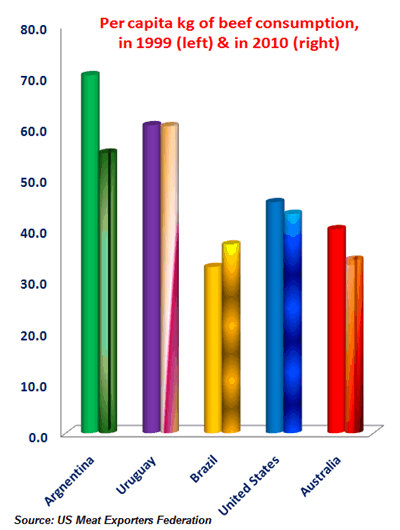 Indeed, Brazilians now eat more beef per capita than Australians and the amount is poised to keep rising by roughly 1% annually for a long time. When a 1% rise in Brazil's per capita meat consumption is compounded by population growth of nearly 2% a year and export growth of at least 2% over the next decade, the most conservative forecasts sees Brazilian meat output jumping by at least 50% over the next decade.
 Argentine beef woes
Brazil's situation is entirely different from that faced by its traditional Latin American meat exporting rival. Whereas Brazilian beef consumption is poised to rise strongly for at least 15 to 20 years, Argentine beef consumption per capita fell from 70kg in 2000 to 55kg this year, while Uruguay's has stayed at a flat 60kg over this time. With their population in the tens of millions, falling consumption at home makes these smaller South American countries more dependent on exports than their Brazilian counterparts. For unlike Brazil, they cannot entirely lean on a large domestic market to maintain their economies of scale.
This is especially true in Argentina, where falling per capita consumption coincided with a severe, two year drought. According to the Argentine Agricultural Sanitary Agency, Argentine beef cattle inventories have slumped 18.3%, from 60 million head to 49 million over the last two years -and are poised to fall further next year. With beef exports down 50% this year, Uruguay will take over from Argentina as the number two Latin American exporter.
Domestic political considerations are also holding back Argentine beef exports. Drought-induced slaughtering caused cattle prices to spike. To ensure lower domestic prices and sufficient domestic supplies, the government limited 2010 beef exports to 350,000 tonnes, which is 16.5% lower than 2009's 419,300 tonnes. To further increase domestic beef supplies, in May 2010, the government raised the minimum cattle slaughter weight to 153kg.
The situation caused January to July cattle shipments to fall from 222,000 tonnes in 2009 to 110,000 tonnes this year. Main export destinations included Russia, where volumes doubled over 2008, with the EU taking second place. Hong Kong and Chile is seeing Argentine imports grow quickly but from a very low starting base and in very limited size markets. Going forward, China recently decided to allow Argentine beef but with export restrictions in place, such liberalizations will only have a very limited effect.
However, with cattle farmers unable to get top dollar for their meat at home and being banned from exporting abroad, many were not in the mood to expand herds after the drought ended. This in turn makes it difficult to raise cattle inventories or exports. It also leads to low domestic beef supplies, which, ironically, is the situation the government was trying to remedy. Nor has the situation merely hurt the livestock end of the chain. Word has it that Brazil-based JB SA, the world's largest producer of red meat, is considering selling its Argentine beef processing plants.
 Feedlots, US competition on the ascendancy
Despite Brazil's successes and Argentina's difficulties, one trend common to both countries is a transition from grassland cattle raising to feedlots. In both countries, rising grain export demand from Asia has raised the return on raising coarse grains and oil seeds. Hence, to enjoy profits from both exporting beef and exporting feed materials, Brazil and Argentina are both converting substantial tracts of land formerly used for cattle grazing to corn and soy growing, while transferring cattle rearing to feedlots.
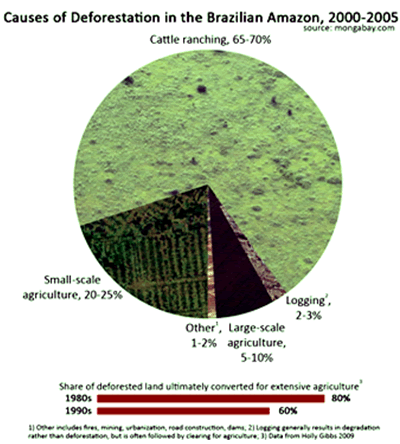
In Brazil for example, the government reports that the number of cattle raised in feedlots grew from 950,000 in 1990 to over two million in 2010. As farmland formerly used for cattle are converted to feed grain and oil seed production, the new feedlots often are located in northern Brazil, sometimes in the controversial Amazon river region. As the accompanying graphic clearly shows, this does much to expose Brazilian beef exports to criticism about environmental destruction and sustainability.
This move to feedlot farming is far more advanced in Argentina. There, government subsidies encouraged the transformation of famous Pampas cattle-raising grassland to soy growing and the simultaneous movement of cattle from the Pampas to feedlots. Export taxes paid on soy sold overseas is also rebated back to feedlot cattle growers. In all, six million of Argentina's 15 to 16 million beef cows now are raised in feedlots, which the government subsidises to the tune of US$250 million per year.
And it must be said that this transition to feedlot farming will be very crucial to Brazil's ability to continue growing its beef sector. With Brazil's currency having nowhere to go but up, the last thing Brazil needs is to be exposed to America's superior beef raising productivity. As mentioned in the previous hot topic article ("The renaissance of American beef"), American beef's trade fundamentals are undergoing a considerable strengthening.
The five year party where mad cow disease kept US beef exports out of choice EU and Asian. At this time, even as US beef exports resume, Europe continues to cherry pick individual Brazilian cattle farms that are deemed as not conforming to EU standards. A recent Greenpeace report, "Slaughtering the Amazon," is starting to give Brazilian beef similar public image problems to that suffered by US beef a decade ago.
As the US dollar migrates towards purchasing power parity and Brazil's real rises towards it, the country must raise productivity to compensate for its rising international price of Brazilian beef. This will involve the introduction of intensive, high productivity rearing methods that assume the feedlot cattle raising model.
Brazil is certainly not waiting for any of this to happen. For example, government loans through its official Agriculture and Livestock Plan provides credit to livestock farmers while funding cattle breeding programs and the modernization of meat processing facilities. There also exist government programs for cattle genetics, tax rebates for slaughtering younger cattle and subsidised phytosanitary upgrading.
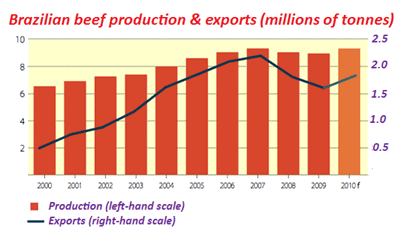 Brazil is OK, Argentina is not
And we can see evidence of Brazil's ability to keep up to a falling US dollar. Since 1990, the number of Brazilian beef and dairy cattle increased 24 percent but beef production increased by 86%. Using superior feed and breeding techniques, between 1990s and 2000, the average slaughter age of the country's ubiquitous Nelore cows fell from 42 to 48 months to 32 to 40 months, saving much in feed costs. The most impressive part of Brazilian beef's productivity story is that it was done while refusing to use antibiotic growth promoters (AGPs), as this would have compromised the country's access to the lucrative EU market.By comparison, Argentine and Uruguayan beef face different sets of challenges and require a different marketing approach. With its higher wage levels, lower feed surpluses and smaller resource endowment, Argentina and Uruguay cannot afford to beat Brazilian -or American -beef on cost alone. However, both countries have a reputation for exceptionally high quality meat.
Hence, we see a future where the United States and Brazil hold most of the world beef export market because of their higher productivity and low production costs, alongside their superior feed grain growing bases. With its smaller domestic market, Argentina will be more subject to export volatility but can partly compensate for this by turning their exports into high-end niche products.
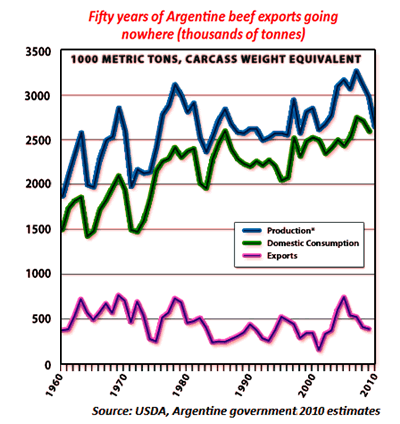 Here too however, we see a contradiction: grass fed beef is increasingly being sold at very high premiums but Argentina is increasingly migrating to the standardized feedlot model.
 Hence, we see two very different regional dynamics at work in South American beef. Brazil resembles the early 20th century United States, with abundant surpluses of feed, rapidly expanding domestic demand and a large capacity to marry mass production with high productivity. It only needs to maintain its cattle raising sector's momentum to enjoy a lion's share of beef exports, alongside the US and Australia. In the 21st century, Brazilian beef, alongside American beef, define the mass market's mainstream.
On the other hand, Argentina, which has a reputation for very high quality beef, finds itself beset by several simultaneous conundrums. It wants to maintain domestic supermarket shelves well-stocked and prices low to the point of restricting beef exports. This however, is destroying the incentive to maintain cattle herds, let alone expand them. Even as its exports fall and Argentine cattle numbers dwindle, its historically high domestic per capita consumption has fallen more sharply than that of any other major beef producer over the last ten years.
At the same time, Argentina is trying to minimize costs by migrating to the feedlot model. The feedlot model however, emphasizes cost control, where Brazil holds the trump card. Hence, Argentina finds itself caught between high costs, a feedlot model that might make its Pampas steak less distinctive and highly damaging government intervention. All this comes after 50 years of stagnation where the country's role in beef export markets has steadily declined.
For Argentina, removing government restrictions on beef exports and slaughter times would only be a start. For while that would remove the disincentives that are shrinking its beef herds, it would not address Argentine beef's long-term structural problems.
For the latter, it should study the business model of high-end American and New Zealand producers who raise a small but very expensive quantity of beef on traditional pastureland. It could very well be that despite Latin America's spectacular success with beef exports, the feedlot cattle raising model is more suitable for Brazil than for Argentina or other small, high-end producers.
All rights reserved. No part of the report may be reproduced without permission from eFeedLink.