
South Korea's meat market revisited: An invasion of American beef
Just three months after US imports were allowed to resume, America is poised to overtake Australia as South Korea's largest supplier of foreign beef. Yet, both America and Korea need a re-think in their market approaches.
An eFeedLink Hot Topic
By Eric J. BROOKS
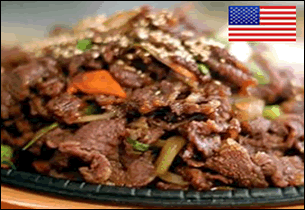 Several months ago amid intense political demonstrations, we visited the touchy subject of imported American beef in South Korea. Since then, a political settlement was hammered out and import liberalization went ahead as planned.
 US beef imports to surge ahead of Australia?
Revisiting the topic of South Korea's beef market just three months later, we find US imports are doing rather well. In May, US beef imports into South Korea amount to barely 1 percent of Australian beef's tonnage. From this nearly non-existent volume a few months ago, it now appears that American beef has overtaken imports from both Australia and New Zealand to command the largest share of the import market.
Even that understates the spectacular market transformation that occurred. In August, the US had already gone from near zero imports just months earlier to take a 23.2 percent share of the South Korean frozen beef import market. This catapulted the United States ahead of New Zealand and Mexico but left it behind Australia.
Just six weeks later and the tables have fully turned. In the critical September 1st to September 10th Chuseok (Korean Thanksgiving) period, US beef accounted for 48.1 percent of imports, with even Australian beef taking second place this month. Not every month will be as good for US beef as was September but it has the means and momentum to potentially unseat Australia. This will especially be the case if recent financial market crashes cause a strong decline in the value of the US dollar.
Much more beef is on the way…
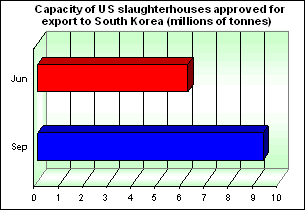 Furthermore, there is even more American beef to come; perhaps much, much more. In addition to the 30 American slaughterhouses approved for exporting beef to South Korea, the government approved an additional 18. This strongly increases the total number of US slaughterhouses allowed to export beef to South Korea from 30 to 48. Whereas the export capacity of the first 30 approved US slaughterhouses was 6.2 million tonnes, the combined capacity of the 48 approved slaughterhouses will be 9.3 million tonnes. This increases America's capacity to export beef to South Korea by 50 percent over the previous amount.
While America's capacity to supply beef is ramping up, demand for US beef might be on the verge of rising even higher too. When American beef was allowed into South Korea, large volume department stores and discount superstores such as Lotte, Homeplus and E-mart opted not to sell it. With American beef so popular, they are now considering selling it, as they fear losing sales to smaller stores that do.
American beef wins on price…
 Needless to say, all this puts South Korean beef in a very weak position at a most inopportune time. Indeed, Korean beef was already facing stiff price competition from Australia and New Zealand before the flood of American beef commenced.
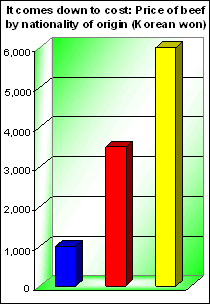
For in this tale of American beef's success, price makes up the entire story. 100 grams of US beef retails for Korean Won KRW1,000, Australian and New Zealand beef is at approximately KRW3,500/100g while domestic Korean beef retails for around KRW6,000.
Even without this import surge, Korea's beef sector was already overdue for a shakeout. The number of Hanwoo (domestic Korean) cattle had jumped approximately 36 percent from 1.84 million in 2006 to over 2.5 million by the middle of this year.
Feeling cornered in their own market, Korean beef and cattle producers are taking steps to fight back. First, South Korea's minister for food, agriculture and fisheries, Chang Tae-Pyong, has said that he intends to seek industry cooperation and arrive at an agreement to reduce cattle inventories, particularly the bloated ratio of cows to bulls. He intends to iron out details and perhaps introduce incentives to bring supply in line with demand later this fall.
Second, the National Agricultural Cooperative (Nonghyup) intends to lower the retail price of domestic beef. It intends to do so by setting up a non-profit beef distribution cooperative that will cut out the middle men who help keep Korean beef so expensive.
Even so, removing middlemen will not close the price gap between Korean and Australian beef, let alone cheaper American imports. For Korean beef to survive, it should tear a page from the comparative strategies of US and European car makers in the mid 20th century.
…but not on quality

In the world of 21st century beef, we see the same mentality at work. Among western consumers, US beef is increasingly lambasted for a wide variety of short cuts and cost-cutting measures that affect quality. Western consumers' criticism of US beef encompasses the alleged overuse of antibiotic growth promoters, giving cattle inexpensive feed too rich in omega 6 fats and unsanitary slaughterhouse conditions covered up by post-processing irradiation. Many of these cattle raising and beef processing practices are banned in the EU or not widely used in Australia or New Zealand, with the latter boasting that its cattle continue to be grass fed in a traditional manner.
Consequently, it looks like US beef exports will mirror the glory days when it dominated the global auto industry. American beef will probably take the lion's share of the market's lower end, as that segment is highly sensitive to price. As was the case in cars, the EU, joined by Australia and New Zealand, will occupy smaller, but highly lucrative, revenue rich pieces of the Korean beef market's top end.
Korean beef must go upmarket
 We already see this trend in action in the demographics of South Korean beef imports. Apparently, young Korean mothers and educated, high income consumers continue to shun US beef in favour of Australian or New Zealand beef, which they perceive as being of higher quality and healthier to eat. Among international cooks and gourmets, many rate beef everywhere from Argentina to New Zealand to Japan as being tastier than US beef.
The implication of all this is crystal clear: The road ahead for Korean beef is to accept its higher cost base and use it to create a unique, Korean beef brand based on cattle fed traditional, healthy, omega 3 oil-rich feeds, free of antibiotics and never irradiated. New Zealand's "Grass Fed Beef" and "Pure Food from a Pure Land" campaigns for meat and dairy products demonstrate the power of such an approach to attract wealthy, educated customers from around the world. With Korean beef at the center of glorious traditional meat dishes, it can easily leverage this rich cultural legacy to win back the hearts and wallets of its own people –and of a growing army of Korean beef connoisseurs around the world.
American cattlemen, study your automobile industry
As for the Americans, they may wish to study ghostly comparisons between their meat exports and their once great automobile sector. Germany invented the car but thanks to the US's low production costs and mass production, America once produced more than half of the world's cars -and she did it at a very low cost. The United States looked as unbeatable in cars back then as she does in beef today…
…Then, one day, Japan began to manufacture reasonably good automobiles at a very low cost. With no reputation for quality to fall back on and its price advantage destroyed, the US automobile industry quickly shriveled away. By emphasizing price too much and not focusing on quality, the US loses the top end of South Korea's beef market today and risks losing the entire industry tomorrow.
All rights reserved. No part of the report may be reproduced without permission from eFeedLink.