
September 18, 2013
Norwegian salmon farming's sustainable intensification
Skyrocketing production, high aquaculture wages, falling unit costs, densely populated cages and plunging antibiotic levels in the meat. Is there a lesson in all this for Asian aquaculture?
by Eric J. BROOKS
An eFeedLink Hot Topic
While most of the world's farmed fish are raised in Asia, the fact they are not raised in an optimally efficient manner can be seen by the nature of how its aquaculture sectors compete: Asian aquaculture competition frequently means looking over one's shoulder at your neighbouring country's relative wage level, using antibiotics to keep costs down -and praying that importing countries do not blow the whistle on their high levels in your fish.
By comparison, Norway's wage-immune salmon farming showcases an entirely different -and pre-eminently successful- approach to sustainable aquaculture. Speaking at The Aquaculture Roundtable Series 2013 Conference in Singapore, Bjorn Myrseth, CEO of Vitamar A/S, explained how Norway's salmon aquaculture industry used scale economies, marketing and sustainable disease prevention to become a role model for developing countries, where most farmed fish are grown.
While NGOs shame the aquaculture industries of Vietnam or Thailand for their low wages or unsanitary, antibiotic-laced fish raising methods, Norway's salmon industry maintains its high growth rate and competitiveness while offering the world's highest aquaculture wages and safest farmed fish. Below, we examine how the Norwegians transcended their high wage trap to achieve the same goals as Asian aquaculture, but through an entirely different method.
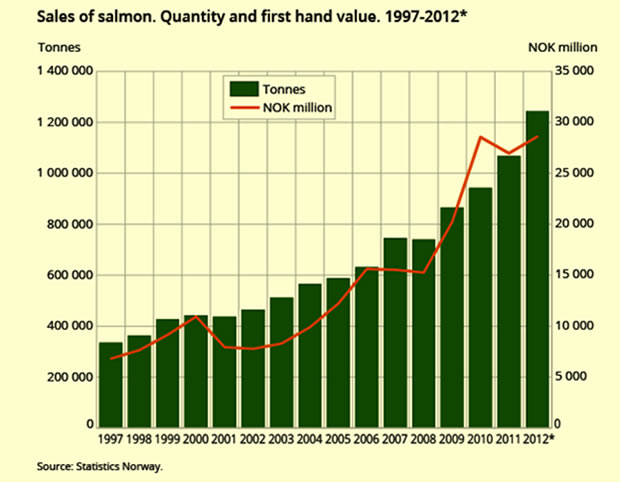
Even though it is the world's oldest, most mature and technically advanced aquaculture sector, Norway's salmon farming industry continues to grow at more than 5% annually, with analyst firm Kontali estimating that it expanded by 9% per annum from 1990 to 2012, and by 5.9% annually since 1997.
Productivity leaps via scale intensification
According to Statistics Norway, salmon output rose 228% in 15 years, from 375,000 tonnes in 1997 to 1.23 million tonnes in 2012. Or to put it another way, since 1973's production of 173,000 tonnes, output has jumped 6,110%. As salmon is a high-end fish consumed mostly in slow growing developing countries, this success is based not just on the meeting of demand growth but cost-based penetration of mature markets.
With a tiny population of just 6 million, 97% of Norway's farmed salmon production is exported. Its 33% share of the world salmon market is only rivalled by Chile's 31% -but even Chile maintains its high salmon output growth through the mass importation of technologies, capital equipment and sustainable rearing methods, much of it from Norway itself.
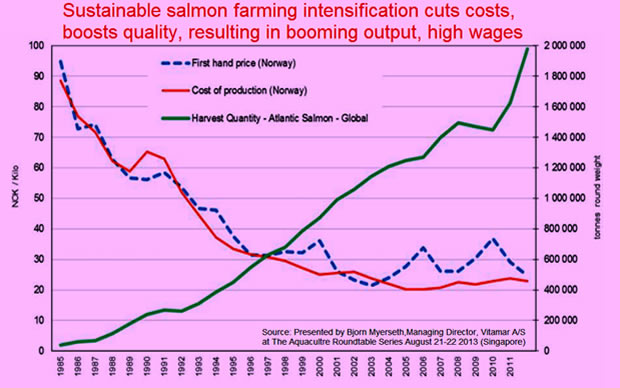
Through the successful pursuit of farming intensification, larger, more densely populated salmon farming cages where used, such that over 26 years, productivity jumped 1,240%, from 30 tonnes per man year in 1985 to 402 tonnes per man year in 2011.
With productivity skyrocketing, production costs per man year plunged, falling 76%, from NOK68/tonne (US$11.56/tonne) in 1985 to NOK16/tonne in 2005, before feed cost inflation made them rebound to NOK20/tonne by 2011. Essentially, an intensive substitution of capital in place of manual labour allowed Norway to offer the highest fish farming wages in the world, even as production costs fell through the floor.
According to Norman Lim, Merck Animal Health's regional technical manager for Asia Pacific, in 1985, an average Norwegian salmon cage had a volume of 550m3 , and produced 180 tonnes of salmon annually was manned by 6 workers. By 2012, Norwegian salmon farms used 60,000m3 cages that produced 1,100 tonnes annually while being manned by only two workers. With each worker producing approximately 18.5 times more salmon in 2012 than in 1985, it was an easy matter to boost wages while boosting output and lowering production costs.
Impressively, despite Norwegian aquaculture's maturity and high development level, salmon farming, output jumped by 2.6 times from 2005 to 2011. This was powered by a 104% rise in productivity per man hour between 2000 and 2011. Though smaller than the 226% increase from 1990 to 2000, this was an incredible achievement for a country too technically mature to import technology from abroad.
Salmon production costs fell from US$7/kg in 1973 to US$4/kg in 2006 and US$2.50/kg in 2013. But it was the post 2000 fall in costs that is in many ways the most interesting.
Vaccines helped by genetics, feed
Every livestock farmer knows that intensive animal cultivation carries with it the price of higher losses to disease. In aquaculture. This usually offsets many of aquaculture intensification's gains. In Asia, this trade-off between intensification and disease-borne losses is avoided using high enough antibiotic levels to create concerns about long-term human health and food safety.
And despite its achievements, at one time, Norwegian farmed salmon was criticized for its high antibiotic levels, much like Vietnamese catfish or Chinese carp growers are at the present time. Essentially, Norway's salmon farmers found an ecologically sustainable means of overcoming the contradiction between productivity gains of intensification and the disease outbreaks that accompany profitable (but unnatural) high population densities.
According to Myerseth, Norwegian salmon's ability to transcend this issue and enter a new phase of growth rested on three factors: "genetics, feed [quality], vaccines and capital equipment." Out of these, he made clear that during its last phase of growth, vaccines played a key role.
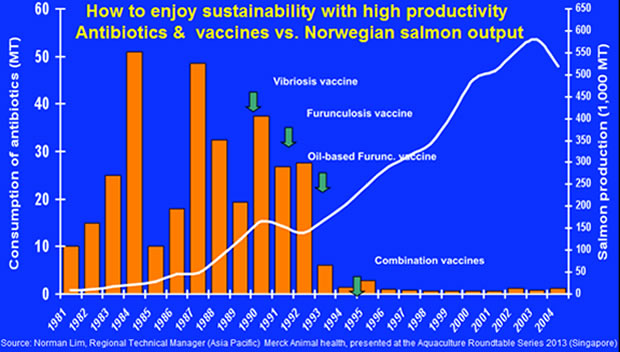
As the accompanying graph shows, even though Norway's farmed salmon output has jumped sharply since the 1980s. Even so, the industry is only using 4% as many antibiotics in 2013 as it did in the mid 1984, even though it is raising nearly 20 times as much salmon. That is because a succession of vaccines, genetically productive fish and high quality feed were substituted in place of antibiotic growth promoters.
Net result? With vaccines providing immunity against diseases, it was possible to boost cage scale and grow salmon in intensive, dense, automated cages, without resorting to dangerous antibiotics, as either growth promoters or disease abatement agents. After the last major vaccine against infectious salmon anemia (ISA) was introduced in the mid 2000s, along with help from continually improved genetics and high quality feed formulating inputs, production costs fell from near US$4.00/kg to US$2.50/kg today.
When one takes inflation into account, that is, in real terms, a 90% fall in unit production costs since the 1970s. In the process, a fish once more expensive than beef (and with a higher feed conversion ratio in its wild catch form) became less costly than tilapia.
All this innovation and market penetration is also supported by collective industry action. When Norwegian salmon is exported, 0.75% of revenues go into a general export marketing fund, and another 0.35% of revenues are used for R&D. In 2012, these small tariffs gave Norway's salmon farms budgets of US$86 million and US$40 million for their collective R&D and marketing efforts, far more than is spent by the combined aquaculture industries of several other major aquaculture producing countries put together.
But collective industry efforts go far beyond shared responsibility for marketing and R&D: Consolidation and vertical integration also play a role in the Norwegian model's success. Even though output increased at rapid pace over many decades, the number of Norwegian salmon farming companies has fallen from 800 companies 40 years ago to under 100 companies today and less than 50 within 5 years.
Warning that, "Fish farming itself is the riskiest part of salmon cultivation,"Myerseth counters that vertical integration enables the leveraging of both revenue, risk and capital expenditures across the entire supply chain. This plays a great role in avoiding the industry disruption that occurred in Vietnam, where singular, standalone fish farms plunged when bank financing dried up.
Hence, a process of continuous, capital intensive innovation divorced Norwegian's salmon farming from the fear of wage competition. Along with joint industry efforts, consolidation created the deep pockets and financing to create a sustainable, ecologically friendly industry that competes internationally even as Norwegians enjoy some of the highest personal incomes in the world. Although the mindset, consolidation and technical approach is difficult to replicate in the developing world, the first Asian nation that does so will become a champion, wage-immune exporter of farmed fish species in its own right.
All rights reserved. No part of the report may be reproduced without permission from eFeedLink.