
August 2, 2017
A new chapter in Ecuador's shrimp boom
Multinational feed giants invest in the world's largest sustainable shrimp exporter as output, exports grow faster than expected. Large grow out sizes coincide with Chinese demand for heavier head-on shrimp. Sustainability to become an important value-added selling point.
By ERIC J. BROOKS
An eFeedLink Hot Topic
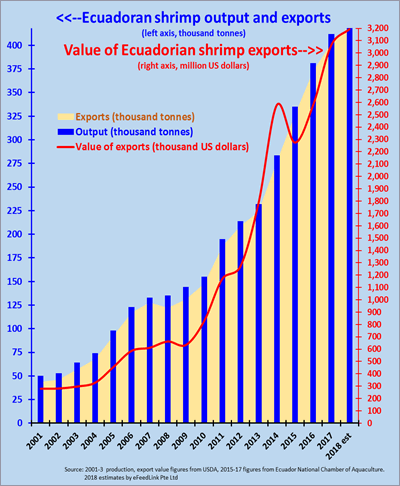 After fifteen years of near exponential growth, Ecuador's export-driven shrimp sector is decelerating but still growing faster than expected. 2016 exports of 372,600 tonnes were up 14.6% on 2015's 326,700 tonnes. Despite some challenges created by exceptionally heavy rainfall earlier this year, 2017 exports have also gotten off to a healthy start.
According to the Ecuadorian Chamber of Aquaculture (ECA), H1 2017 exports totaled 206,163 tonnes, up 15% from 179,000 tonnes shipped in the first six months of 2016. ECA president Jose Camposan conservatively projects that shrimp exports will rise between 7% to 9%, from 2016's 372,600 tonnes to between 399,000 and 406,000 tonnes this year.
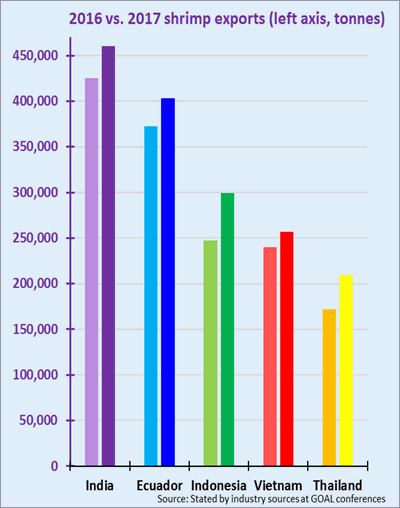
With roughly 98% of this year's approximate 412,000-tonne output destined to be shipped overseas, Ecuador is not the second largest world shrimp market supplier but its most export-oriented. It is also achieving 400,000 tonnes of farmed shrimp production a year earlier than expected: At the September 2016 GOAL conference in China, industry stakeholders projected that Ecuador would only achieve 400,000 tonnes of output in 2018.
Going forward, a new Free Trade Agreement (FTA) between Ecuador and the EU took effect at the beginning of this year. By abolishing the EU's 3.4% import duty on Ecuadorian shrimp, it makes producers more cost competitive while giving both buyers and exporters the assurance of guaranteed market access. For while there is great talk about surging Ecuadorian shrimp exports to Asia, the EU already buys more Ecuadorian shrimp than either China or America (which also has a free trade agreement with Ecuador).
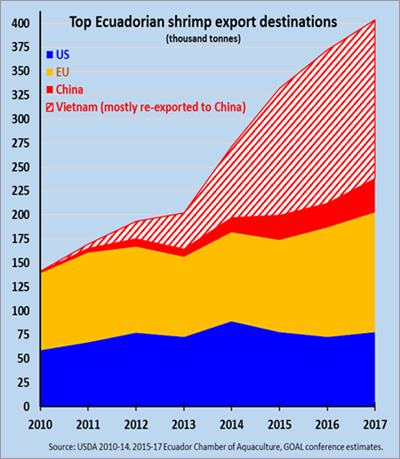
Moreover, this FTA's implementation coincides with the US dollar (which Ecuador uses as its currency) falling 13% in value against the Euro since mid-2016. Along with the FTA's tariff reduction, this slashed the cost of Ecuadorian shrimp by 15% for European buyers over the past year. If the new FTA shifts European buying patterns, the EU could rival Vietnam (which imported 160,000 tonnes in 2016) as the world's largest buyer of Ecuadorian shrimp.
In an April 26, 2017, interview with www.seafoodsource.com, Valeria Escudero, the Ecuadorian French embassy's commercial consul stated that "The new trade agreement has made a big difference to our shrimp producers, with European exports up by 10% already this year. This success builds on a year-on-year increase in exports to Europe in 2016 of 19%." From a USDA estimated 93,270 tonnes in 2014, Ecuador's shrimp shipments to the EU are likely to exceed 125,000 tonnes this year.
Europe also matters because Ecuador appears to have maxed out its prospects in the US market, where tariff-free market access provided much of its early export demand. Calling the US, "a mature market', Gabriel Luna, a shrimp farming analyst speaking at a conference sponsored by supplier Nicovita stated, "our US exports have reached a limit." Hence, the importance of a new, large western market to replace America as a growth driver.
While the EU is taking over from America's role as a wealthy growth market, Ecuadorian shrimp's real future is in Asia. According to Luna, in January 2012, American and European buyers collectively purchased four times more shrimp than Asian importers, when they collectively bought 9,200 tonnes between them. That same month, Asian buyers bought just under 2,300 tonnes of Ecuadorian shrimp
By January 2016, US and European imports of Ecuador jumped over 50%, collectively totaling around 13,700 tonnes. By comparison, Asian imports of Ecuadorian shrimp skyrocketed 400% over these same four years and totaled 11,500 tonnes that same month.
This year, total Chinese and Vietnamese imports of Ecuadorian shrimp will exceed the sum of what is shipped to Europe and America. Moreover, it must be mentioned that official statistics overstate real Ecuadorian exports to Vietnam while understating Chinese volumes. This is because much of the shrimp Ecuador exports to Vietnam is then re-exported to China.
Exports to Asia initially surged during the EMS outbreak, filling a world market vacuum created by collapsing production in China and Thailand. Here too, fortune has smiled down on Ecuador: The inability of Chinese and Thai shrimp output to recover to pre-EMS levels and growing world market demand made permanent what was expected to be a temporary EMS driven export windfall.
 According to Robins McIntosh, CP's senior vice-president for aquaculture, China's EMS woes did more than devastate its world leading shrimp output: To avoid EMS infection (which usually appears in later grow-out phases), the Chinese are harvesting their shrimp early, leading to a shortage of highly favored, large size shrimp in that country.
 As Ecuador makes up for its low pond stocking densities by growing larvae to exceptionally large sizes, China has taken to importing its high, quality, exceptionally large Ecuadorian shrimp. Luna confirms that, "We are a niche provider in China for restaurant consumers that are not going change their buying patterns [favoring large size shrimp]." Furthermore, exporting semi-processed head-on shrimp favored by European and Chinese buyers also greatly reduces labor costs, where Ecuador is at a disadvantage to lower-income Asian countries.
Moreover, unlike its Southeast Asian competitors, the Ecuadorian shrimp farming model is keynoted by its sustainability. According to the USDA, 60% of Ecuadorian output is produced by extensive, land hungry farming systems and feature stocking densities of 8 to 14 larvae per square hectare.
The other 40% mostly uses varying degrees of semi-intensive farming methods, stocking anywhere from 15 to 120 larvae per square meter. Even so, at 15 to 20 larvae per square meter, Ecuador's average pond stocking density is very low and a mere fraction of the 40 to 100 per square meter levels commonly found in East Asia.
It partly counteracts the disadvantage of low stocking density by growing white leg shrimp to very large sizes compared to Asian growers. Unlike China or parts of India, Ecuador's equatorial location allows it grow three shrimp harvests a year.
While Ecuador is not in any hurry to boost its shrimp farming density, the quality and quantity of inputs is rapidly rising and undergoing important changes. Since the middle of this decade, there has been a raft of large investments in new shrimp feed facilities.
In 2013, Skretting paid €81 million (US$105 million) to acquire 75% equity in Gisis S.A., which was Ecuador's leading shrimp and tilapia feed producer at the time. The company's two Ecuadorian feed mills produced over 60,000 tonnes of shrimp feedback then at a time when Ecuador produced 350,000 tonnes of shrimp feed (2016 output is more than double this figure). Along with Gisis's Honduran and Peruvian facilities, the 200,000 tonnes of shrimp feed produced by Gisis at the time catapulted Skretting into becoming the third largest shrimp feed producer in the world.
Thereafter in mid-2015, Cargill announced its 75% equity investment in a US$30 million joint venture with local shrimp grower and processor Naturisa. They constructed a 130,000 tonne/year capacity, 260 employee shrimp feedmill just outside Guayaquil, Ecuador. Commencing operations earlier this year, the new facility supplies shrimp feed to both Ecuadorian farms and those in neighboring Central American countries.
In May of this year, Denmark-based BioMar announced that it had acquired a 70%, DKK800 million (US$121 million) equity stake in Alimentsa, a leading Ecuadorian shrimp feed supplier. Based in Guayaquil, Ecuador and founded in 1986 by German and Danish investors, Alimentsa's mill employs 145 people, with an 110,000 tonne/year capacity and an estimated output of 90,000 tonnes/year. With revenues totaling DKK500 million (US$76 million) in 2016. BioMar estimates that Alimentsa accounts for 10% to 15% of Ecuador's shrimp feed production.
While it complements BioMar's existing Latin American shrimp feed mill in Costa Rica, the acquisition reflects how Ecuador now exceeds the combined shrimp output of neighboring Central American countries. BioMar CEO Carlos Diaz believes that Alimentsa's reputation and presence in Ecuador's rapidly growing shrimp sector fit well with within his firm's borderless operational scale, innovation and capacity for acquiring inputs.
Diaz cites BioMar's, "Long-standing R&D track record, including experience in substituting the scarcest resources [e.g. plant-based inputs in place of fishmeal]. As a global group, we will be able to contribute cheaper and better procurement sources and a comprehensive global sales network."
Having outgrown its previous 2013 Ecuadorian shrimp feed acquisition, this July saw Skretting announce another, substantially larger investment: It is constructing a new, 3.5 hectare, US$65 million shrimp feed facility that will have a production capacity of 470,000 tonnes/year –more than Cargill and BioMar's combined Ecuadorian shrimp feed output. Situated in Duran, Ecuador, the first phase of Skretting's new plant will commence operations in H1 2018. Thereafter, the second phase will be built, with an expected completion date in 2019.
Whereas investments by BioMar and Skretting leverage scale, expertise and market share horizontally within the shrimp feed line itself, Cargill's investment points towards vertical integration: Besides holding 25% equity in the joint venture, Naturisa grows 20,000tonnes/year of its own shrimp and owns 50% of Songa, Ecuador's fourth largest shrimp processing plant and shrimp exporter by volume. The latter processes 180 tonnes/day of shrimp. It exports over 20,000 tonnes of the 80,000 tonnes of Ecuadorian shrimp shipped to the United States annually.
 On one hand, the investment gives feed input supplier Cargill scope for additional vertical integration with Songa's network of shrimp farms and processing plants. On the other hand, Songa is able to tap Cargill's extensive North American distribution network and tariff-free access US market access to easily boost shrimp exports to the United States.
Investments by multinational integrators and shrimp feed suppliers do more than express confidence in Ecuador's low-density shrimp farming model. Both they are their Ecuadorian shrimp growing climates see sustainability and food safety as long-term selling points. For unlike other nations where shrimp farming has decimated mangrove forests,
In 2014, the Monterey Bay Aquarium NGO Seafood Watch upgraded Ecuadorian shrimp's safety and sustainability status to code yellow and classifying it as a, "Good Choice" for human food consumption. This contrasts with shrimp from China, Thailand, India, Indonesia and Malaysia which are on its "avoid" list due to antibiotic overuse, destruction of natural habitats and other sustainability issues.
By comparison, Seafood Watch's report states that, "Shrimp farming in Ecuador uses low-intensity production strategies, and probiotics [not antibiotics] are the preferred form of health management." All antibiotic dosing is recorded by law and that only oxytetracycline florfenicol are used in moderate amounts. Stating that, "There is little evidence to support a current concern over antibiotic abuse", Seafood Watch concluded that, "Shrimp are raised free of hormones, antibiotics, or other contaminants."
Best of all, the supply chain partners of Ecuadorian shrimp farms are also seizing on opportunities created by its sustainable business model. Along with being a leading Ecuadorian shrimp feed supplier, Skretting has introduced shrimp feeds formulated to boost disease immunity and render reliance on antibiotics unnecessary. It claims to have developed, "The right combination of novel functional ingredients in the shrimp feeds will work in synergy to support the functioning of the immune system and to help protect shrimp against hostile threats."
According to Dr. Charles McGurk, Manager of Fish & Shrimp Health at Skretting's Aquaculture Research Centre, "Functional ingredients in our feeds enable shrimp farmers to take proactive steps that will support the primary defenses of their stocks against environmental threats, while also playing their part in addressing the antimicrobial [anitbiotic] resistance challenge."
McGurk declared that, "We have proved that shrimp farmers do not have to rely on antibiotics and risk building up antimicrobial resistance in their stocks." –Needless to say, if it becomes possible to use formulated feeds to mass farm shrimp completely free of antibiotics, this will be accomplished in Ecuador's low-density shrimp farms years before the same can be achieved in Asia.
At a time when NGOs are attacking farmed seafood in general and shrimp particularly hard, Ecuador's reputation for sustainable, safe, additive free shrimp can be leveraged as a major selling point. It would be impossible for high-intensity Asian shrimp growers to replicate Ecuador's low intensity, sustainable shrimp farming model. At a time when consumers are increasingly willing to pay a premium for sustainable, additive free seafood, Ecuador can easily leverage its advantages into a long-term upmarket, high-value added niche within the world shrimp market.
All rights reserved. No part of the report may be reproduced without permission from eFeedLink.