
by Eric J. BROOKS
If innovation is fathered by the spectre of necessity, then the past decade has certainly changed the way that we feed our livestock. On one side, Asia's burgeoning meat demand is creating pressure to bring livestock to market faster than ever before.
Meanwhile, feed raw material shortages are forcing millers to use every means available to feed the largest amount of livestock possible with the least amount of feed. In much of Asia, this means using a new generation of organic, sustainable enzymes and additives that enable less feed to be transformed into more meat at a rapid pace.
Alternative feeds, GM crops, organic acidifiers all in ascendancy
We can also be sure that with crop yield increases topping out, governments are looking at ways to erode popular resistance to genetically modified crops - though in Asia, this is at very early stage compared to North America. Moreover, with feed becoming a national security question, some countries are accelerating the market forces that are already consolidating their feed millers.
This decade's worsening grain shortages also drove the rising use of many alternative feeds including cotton seed, cassava and DDGS among livestock, soy and rapeseed in place of traditional fishmeal. This time around, alternative feeds are being made successful through the careful application of amino acids, enzymes and key additives.
For example, DDGS has been heavily criticized for its highly variable nutrient quality and mycotoxin levels. Yet, according to Daniel Keefe, manager of International Operations-DDGS for the USGC, DDGS exports to Asia are now growing at a near exponential pace. He adds that, "here on in, we expect China, India, Japan and other main markets to be our new source of growth."
This was made possible through a combination of techniques. First, DDGS samples are tested for nutritional levels and amino acids, with vitamins added where necessary to create consistent nutrient ratios across various batches. Secondly, companies such as Biomin and Pancosma are answering DDGS's mycotoxing contamination threat with a new toxin binders designed for DDGS and other alternative feeds. Meanwhile, China, despite using much domestically produced DDGS often incorporates American DDGS into its feed, as the latter has much higher lysine levels, thereby reducing supplementation costs.
Nevertheless, when using such alternative feeds, many challenges remain. For example, Thailand enjoys large supplies of cassava and is at the forefront of incorporating it into livestock feed. Yet, Mr. Porsilp Patcharintanakul, President of the Thai Feed Mill Association states that, "The incorporation of cassava into feed creates some problems. These involve bulkiness, dustiness and the irregular physical form of the product." While strategic use of amino acids partly mitigate cassava's low protein levels, cassava feed's very manufacture is a challenge: Porsilp mentions that everything from its bulky storage area requirements to hazardous dust emissions must be factored into account.
Acidifiers, elimination of AGPs are export-driven
Meanwhile, even conventional feed is getting a make over. The EU's ban on antibiotics and last year's food safety scare caused large poultry exporters such as Thailand to stop putting antibiotic growth promoters (AGPs) into feed and replacing them with acidifiers With the food safety scare bringing to light many Chinese meat and seafood products with illegally high levels of antibiotics or banned substances, the market responded. According eFeedlink's Shanghai-based analyst Shi Tao, "China's feed millers are responding by putting in non-antibiotic alternatives such as organic acidifiers in feed."
Finally, ongoing consolidation means that innovations will be rapidly transmitted across Asia's feed milling sector. Indeed, the unique demands of alternative feeds such as cassava require specialized, capital-intensive investments. Eventually, only larger, well capitalized feed millers will be able to meet these requirements.
Recently, China restricted the expansion of multinational giants such as Cargill while giving financial and policy support to the consolidation of large domestic feed millers. At this time New Hope, Chia Tai Group, Tong Wei, Zhenghong Science and Technology, Heng Xing, Wen's Group, Tangrenshen Group, Da Bei Nong Group and Zhengbang Group control about a quarter of the market and their share can be expected to increase.
Meanwhile, without government intervention, Cargill Philippines acquired LNB International Feed BV- formerly a Europe-based premix company. On the domestic side, San Miguel Corporation announced a joint venture with Gensan Feedmill to supply B-Meg brand livestock, poultry and aquaculture feed.
Only in Thailand, where CP, Leepatana and Betagro have long dominated feed milling, is no further consolidation taking place. - And coincidentally, in our survey, Thailand emerges as the country with the most advanced feed milling techniques too. It also the only country that extends the concept of consolidation to creating an ASEAN common market in corn.
On the whole however, every country's feed sector is at a different level of technology and development. Conseqently, each must answer a set of challenges unique to its national environment. We look at how well they are responding to this decade's harsh market environment over the following pages.
Coming from behind: With China's meat demand overtaking feed production, innovation is being used to extend scarce supplies
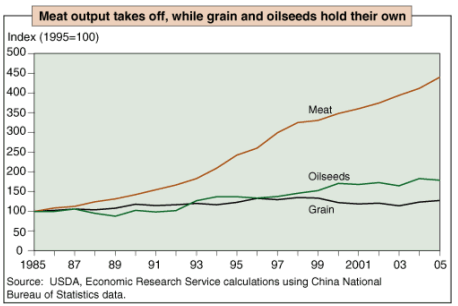
With Chinese feed grain supplies at their tightest in the modern era, feed milling productivity is seen to play a crucial role in extending feed supplies. With both feed and livestock prices rising rapidly, feed millers, particularly those integrated with large-scale farms, face considerable pressure to raise their efficiency.
Phytase tops out but amino acids, acidiers, GM crops are in
According to Shi Tao, eFeedLink's Shanghai-based analyst, "Recent breakthroughs in Chinese feed technology include balancing amino acid ratios to improve feed quality and reduce feed costs. There is also research into using acidifiers and in using plant based protein meals and oil seeds in place of fishmeal."
One ingredient that experienced exponential growth in usage but is now topping out is phytase. Shi states that, "In recent years, the mixture of feed-grade phytase in feed meal like rapeseed meal has been on the increase to aid more efficient breakdown of phosphorous so that feed costs can generate better returns. He adds that, "with per capita phytase use topping out and livestock growth slowing down, so is the demand for phytase."
Moreover, genetic engineering implies that the direct use of phytase itself may be destined for a long-term decline. According to Shi, "use of genetically modified corn that produces its own phytase is still in the experimental stage and not yet approved for use by the government. However, such corn may lower the amount of phytase required, thereby saving costs over the long run.
Often, innovations are not visible in the feed sector itself but manifest themselves downstream in livestock production. Shi comments that, "There have been improvements in the formulation of feed for lean hogs. Using this type of improved feed, hogs are able to reach an optimal weight in a shorter period of time. In my life time, this has significantly reduced the time from piglet birth to maturation."
Alternative feeds take their place
As is the case elsewhere in Asia, alternative feeds are increasingly being drawn into the feed supply chain, with DDGS and rice bran commonly fed to poultry. Shi reports that, "While rice bran has always been used to some extent, today's main non-traditional feed in China is DDGS. It is growing particularly strongly in the dairy sector." Particularly in south China, cassava is being used to replace corn for animal feed." With Chinese national corn reserves hitting alarmingly low levels and this year's harvest looking disappointing, expect demand for cassava and most particularly, DDGS, to pick up strongly in southern China.
Indeed, China's quest to source alternative feed supplies is taking it where most countries would not go. Shi explains that, "while cottonseed meal is known for its toxicity, China has large supplies of this crop. Now, new technology eliminates a large part of cottonseed meal's toxicity. This enables feed mills to use more of it for feed production."
Whey, fishmeal being phased out
Meanwhiule, due to issues of both quality and supply, one finds that animal-based feeds are only sparsely used in China. Regarding the former, Shi reports that, "due to the low quality of locally produced meat, bone or feather meals, China does not use a big volume of these feeds. The only reliable source of these meals is Australia but its high cost is made worse by rising transport fees."
At the same time, shortages of dairy and, most especially, of fishmeal are forcing the substitution of plant-based alternatives, where ever possible. According to Shi, "With the rise of dairy prices, feed mills are cutting down on the usage of whey. As a result, whey is only used for feeding newly-born piglets under one month of age." While the resulting nutritional deficit may result in China's pork quality being below western pork, it has not affected domestic pork demand, which remains very high.
Shi also reports that due to a chronic, intractable global shortage of fishmeal and high prices, "Fishmeal has been substituted by soymeal and rapeseed meal for hogs, broilers and layers." Indeed, even in aquaculture itself, fishmeal's usage is being minimised with a corresponding "rising dependence on rapeseed, cottonseed and DDGS for aqua feed."
Feed antibiotics phased out under export pressure
Along with the rising price of traditional feed raw materials, overseas customers are also driving a change in feed formulations. In particular, last year's food safety scare, which followed on the heels of the EU's ban on antibiotic growth promoters. In response, Shi reports that, "China's feed industry has been replacing a portion of antibiotics with feed additives like phytase, probiotics, oligosaccharides, acidifiers and so on to improve the health of hogs and broilers." He adds that, "hogs that were fed with such improved feed were as healthy as hogs fed antibiotics."
The above are excerpts, full versions are only available in FEED Business Asia. For subscriptions enquiries, e-mail membership@efeedlink.com