
March 23, 2018
Revival, challenges and opportunities in Russia's dairy sector
Will Russian dairy farms finally enjoy the same V-shaped, import substitution powered recovery already enjoyed by the country's sector? With sufficient investment in farm size, scale and feed quality, high-end dairy commodity production could boom.
By Eric J. Brooks
An eFeedLink Hot Topic
 After decades of stagnation, Russia's dairy industry is gradually restructuring itself into a new growth phase. Long an economically weak relative to livestock, the past year has seen Russian dairy farming returns exceed those for raising pork or poultry for the first time since the late 2000s. Coming after years of industry restructuring, the stage is being set to make Russia one of the world's most promising dairy investment frontiers.
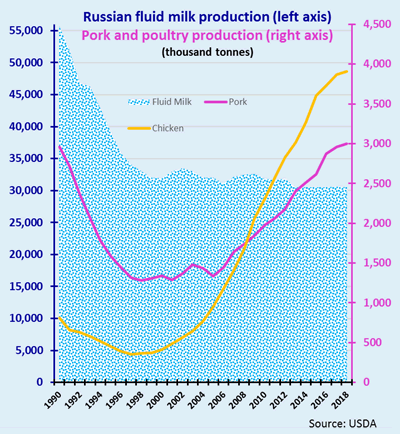
The fourth largest milk producing nation after India, America and China, Russian milk production has been stuck in the 30 to 32 million tonne range since the mid-2000s. But Russia has the resources to do much better and at one time, it did so. Milk production exceeded 55 million tonnes during the late Communist era.
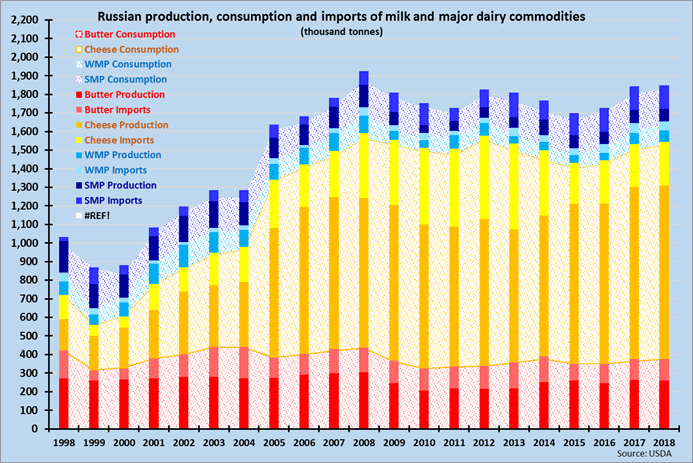
Superficially Russia produces 99% of the fluid milk it consumes. In practice, a quarter of Russian cheese and over 50% of the WMP and SMP it consumes is imported. It is the second largest dairy importer in the world after China, the biggest importer of butter and cheese and a top five importer of WMP and SMP.
When Russia banned EU food product imports in 2014, a large change occurred in Russia's dairy trade, which was once dominated by European supplies. By 2017, 90% of dairy imports were sourced from neighboring Belarus, with Uruguay, Argentina and New Zealand accounting for most of the other 10%. When processed dairy commodities are taken into account, Russia is only 75% self-sufficient in dairy products by volume.
Supply-wise, productivity, cost efficiency and high-end dairy goods production are held back by small-scale backyard farms, which accounted for a USDA estimated 59% of milk production in 2017. Low backyard farm milk quality is also why Russia is so dependent on imports: Large foreign dairy processors operating in Russia estimate that 30% of fluid milk output is of too low quality to be used in the production of high-end dairy goods.
Consequently, approximately 10 million tonnes of its 30.5 million tonnes annual milk production capacity cannot be used to make WMP, SMP, butter, cheese, yogurt, whey or offset imports. -With fluid milk consumption only totaling 4 million tonnes, that wastes a whopping 6 million tonnes of milk that could otherwise have been processed into high-end dairy goods.
It also makes worse Russia's milk supply shortfall: In 2016, the government estimated that Russia requires annual fluid milk output of at least 40 million tonnes if it is to achieve self-sufficiency in processed, high-value dairy goods.
The resulting shortfall of high-quality milk impacts does more than constrain supplies or prevent dairy commodity self-sufficiency. It makes for an ambiguous reading of dairy production statistics and encourages the proliferation of counterfeit goods. For example, the USDA estimates that 2017 cheese production increased by 6.9% to 925,000 tonnes, from 865,000 tonnes in 2016. The real question is, "How much of this is real cheese?"
In a late December 2017 article with Russia Beyond (www.rbth.com/business/327170-russia-dairy-cheese), French style cheese maker Vladimir Borev stated: "There are many cheese producers that hardly use natural milk, and instead use much water to dilute powdered milk from Belarus and palm oil from Vietnam."
Calling such counterfeit goods "a joke", Borev said that Russian supermarkets contain many locally produced, European style cheeses whose unit price per kilo is below the cost of milk required to produce them. -That is only possible if a significant proportion of non-dairy vegetable fats and artificial flavorings were used in the supposed cheese's production.
Similar problems exist with products labeled as butter, yogurt or ice cream but which are made with plant-based fats and mixed with artificial flavorings. Hence, counterfeit goods made with plant-based ingredients account for a significant but unknown proportion of official dairy commodity statistics.
Borenov's opinion is seconded by Russian Governmental Agricultural Committee director Ivan Rubinov. While Russia's shortage of high-quality milk motivates the production of fake or low-quality products, the problem got a lot worse after 2014, when Russia banned US and EU dairy imports. According to Borenov "Sanctions severely curtailed opportunities for competition. Before, the market was full of goods from Europe [which limited the opportunity for counterfeit cheeses]."
It does not have to be this way -and it may not be in the future. Offsetting all these problems is Russia's large arable land endowment, much of which is ideally suited for dairy farming. Vivek Verma, managing director and global head of dairy and coffee for Singapore-based Olam Group, states that Russia has everything it takes to be both self-sufficient and internationally competitive in dairy production.
According to Verma "Dairy farming systems in Russia can be scaled up at a relatively lower cost than competing origins due to the availability of good quality agricultural land for forage production and commercial agriculture." He adds that "The country's milk production costs are as competitive as any dairy confinement system in the world… what excites us the most is the potential to achieve scale."
Anxious for its dairy industry to attain the same level of self-sufficiency achieved by its pork and poultry sectors, 2016 saw Russia's government double its annual industry subsidies from RUB15 billion (US$250 million) to RUB30 billion(US$500 million). With financing difficulties holding back much new investment, bank loan subsidies to milk producers were vastly increased from RUB0.3 billion (US$5 million) to RUB1.5 billion (US$25 million). To boost output, the annual reimbursement of costs for constructing new dairy farms or upgrading old ones was boosted RUB2.5 billion (US$41.7 million) to RUB6.0 billion (US$100 million)
On one hand, these policies have not been entirely successful. According to industry reports, some subsidies were wasted on political opportunists who pocket a large proportion of subsidies provided after building economically unviable dairy farms for mere face-saving reasons. Makers of quality goods like high-end cheeses state that due to a shortage of high-quality milk, their production volume always falls short of demand.
On the other hand, there is much change happening that is not yet captured in official production statistics. A wave of new, state-of-the-art milk producing facilities only started coming on stream since 2016. Olam's Verma states that it can take up to seven years for newly opened dairy farms to achieve their maximum productive capacity.
Although fluid milk production has remained roughly constant for over five years, both the quality of the milk and dairy cattle productivity is rising.
On one hand, production appears static, having gone from 30.5 million tonnes in 2016 to 30.60 million tonnes last year and a USDA estimated 30.55 million tonnes this year. Russia's agriculture ministry reports that over the past five years, output at large, integrated producers has risen 3% annually while the aggregate production of small-scale milk farms has roughly the same amount.
On the other hand, the number of cows-in-milk from fell from approximately 8 million in 2014 to a USDA estimated 6.8 million head in 2018 while the amount of milk produced stayed roughly constant. The amount of milk produced per dairy cow has risen from 3.8 tonnes in 2014 to 4.0 tonnes in 2016 and 4.5 tonnes this year. Clearly, the substitution of modern dairy cow breeds and high-quality feed inputs in place of traditional backyard farm cows and farm scraps is profoundly boosting farm productivity and milk quality.
From 2017 through 2020, the government projects that at least 800 farms holding 3,000 or more dairy cattle will commence operations. Russian agriculture minister Alexander Tkachev projected that from 31 million tonnes in 2015, the opening of these facilities will boost Russian milk production capacity to 36 million tonnes by 2020.
All this not promises to boost both the quantity of milk produced but also its quality: Even when milk production remains constant, as the percentage produced by large-scale farms increases, so does the proportion of Russian milk that can be used to make milk powders, cheese and butter at internationally competitive quality levels.
In some ways, Russia's low dairy productivity and high proportion of low-quality milk are what gives it the greatest potential for large increases in the output of value-added products. For example, if production rises by 3% or a million tonnes but the quantity of low-cost milk produced falls by a million tonnes, that represents an extra 2 million tonnes or 12% increase in the 16.5 million tonne supply of high quality fluid milk available for the making milk powder, butter, milk, cheese or yogurt -which can make for nearly a decade of near 10% increases in the annual production of high-end dairy commodities.
Hence, an acceleration in the rate of farm consolidation will enable the production of high-end dairy goods to increase rapidly -and they will have to increase rapidly, too: Russia's economy and dairy consumption is recovering. Unlike the last five years, imports can longer be held constant or reduced merely because of lower consumer demand.
At the same time, with significant investments in milk production and processing capacity additions coming on stream, production will recover enough to keep imports constant amid rising consumer demand over the next few years. By the early 2020s, the reaching of full production potential in farms that have recently commenced production will coincide with the opening of investments now in the planning stage. That should create a situation for sustained, constant increases in milk supply.
While significant additions to milk output levels are still some years away, a rising proportion of the total milk supply will be accounted for by high-quality milk. This will allow production of milk powders and high-value products like cheese to rise more quickly than milk output itself -after the mid-2020s, it should allow the volume of imported butter, cheese, powder to gradually decline.
The bad news is this: As the attached graph shows, just like every other protein line, Russia's dairy sector underwent a severe post-Cold War recession. However, unlike the pork and poultry sectors, dairy never underwent a "V-shaped recovery" or rapid, import substitution-driven market growth.
The good news is that after decades of delay, the groundwork is in place for just such a V-shaped rebound in Russian dairy production, followed by a leveling out and gradual decline in import volumes.
All rights reserved. No part of the report may be reproduced without permission from eFeedLink.