
Impact of medium chain fatty acids, their monoglycerides - and agglomerates of them with diformates against bacteria and viruses - Part II Anti-viral effect
In the first part of this "mini-series" the anti-bacterial impact of medium chain fatty acids and monoglycerides in conjunction with organic acids had been discussed. It was revealed that the addition of 3rd generation acidifier into animal diets provide a significant improvement of the health status of swine.
The second part of the article focusses now on the anti-viral efficacy of those additives.
Mode of action - Impact against viruses
When it comes to the antiviral effect, Sabin et al. (1962) that human milk reduced the infectivity of several viruses, such as herpes simplex virus and poliovirus. In a later study, Welsh et al. (1978) showed that the antiviral activity of human milk was associated with free fatty acids and monoglycerides, released during hydrolysis of triglycerides by milk lipase. In a series of studies on the antimicrobial activity of human milk (Isaacs et al., 1986; Thormar et al., 1987; Isaacs and Thormar, 1990) confirmed and extended these earlier studies. They found that fresh human milk did not inactivate enveloped viruses but became highly antiviral after storage in a refrigerator at 4ºC for 2 to 5 days.
Hornung et al. 1994 reported that in the presence of lauric acid (C12), the production of infectious vesicular stomatitis virus (VSv) was inhibited in a dose-dependent manner. The inhibitory effect was reversible: after removal of C12 the antiviral effect disappeared. In addition, the chain length of the monocarboxylic acids proved to be crucial, as those with shorter or longer chains were less effective or had no antiviral activity.
Monoglycerides can also disrupt a wide range of lipid bilayer-enveloped viruses by damaging and/or effectively destroying enveloped virus particles and compromising infectivity (Jackman et al., 2018).
Several studies have been done to elucidate the virucidal action of fatty acids. Viruses containing a lipid envelope are inactivated and several studies have shown that the inactivation is caused by disintegration of the viral envelope (Thormar et al., 1987; Sarkar et al., 1973; Sands, 1977).
Medium-chain saturated fatty acids are highly active against the enveloped viruses, although the fatty acid concentration required for maximum viral inactivation varied by as much as 20-fold. Monoglycerides of these fatty acids were also highly antiviral, in some instances at a concentration 10 times lower than that of the free fatty acids. On the other hand, MCFAs and monoglycerides are inactive against non-enveloped viruses.
Furthermore, MCFAs and monoglycerides can inhibit numerous types of lipid bilayer-enveloped viruses, among them herpes simplex virus, parainfluenza virus type 2, avian influenza virus, and African Swine Fever virus (ASFv) - (Thormar et al., 1987; Hilmarsson et al., 2007; Hariastuti, 2011; Sola et al., 1986). More recent studies have demonstrated that they also exhibit strong antiviral activity against other swine-specific viral pathogens, such as porcine reproductive respiratory syndrome virus (PRRSv) and porcine epidemic diarrhoea virus (PEDv) which contain lipid bilayer envelopes that are necessary for structural integrity and infectivity (Du et al., 2017; Lee, 2015).
Another important consequence of MCFAs and monoglycerides targeting pathogenic membranes is that it is more difficult for susceptible pathogens to develop resistance to these compounds. It is generally acknowledged that there is a very high barrier for pathogens to develop resistance to fatty acids and monoglycerides (Desbois and Smith, 2010; Schlievert and Peterson, 2012).
Lauric acid has greater antiviral properties than other fatty acids. Furthermore, laurate in the form of monolaurin is more biologically active than free lauric acid in its anti-bacterial and anti-viral impact, as already reviewed in the Part I of the article. On the other hand, the diacylglycerols and lauric acid triacylglycerols are not active against microorganisms (Lieberman et al., 2006).
The antiviral mechanism of monolaurin is by dissolving lipids and phospholipids, which make up the outer part of microorganisms or viruses which then causes disintegration of the outer membrane. Damage to the outer membrane of the virus causes the virus to rupture and die. Other researchers report that the antiviral mechanism is that monolaurin interferes with the signal transduction of organisms and through interference in the process of assembling viral RNA and the process of virus maturation or propagation (Projan et al., 1994; Arora et al., 2011).
Monolaurin has been reported to have the ability to fight various types of viruses, especially enveloped viruses, including various influenza viruses. Hilmarsson et al. (2007) reported that monoacylglycerols with medium-chain fatty acids such as monocaprylin, monocaprin, and monolaurin have good virucidal effects against influenza viruses such as HPIV2 and RSV. The virucidal activity becomes more effective if the pH is lowered to around 4.2. Arora et al. (2011) reported that monolaurin has the potential as an alternative treatment to prevent the pandemic of the Novel H1N1 virus or swine flu virus that once attacked in several countries in the world.
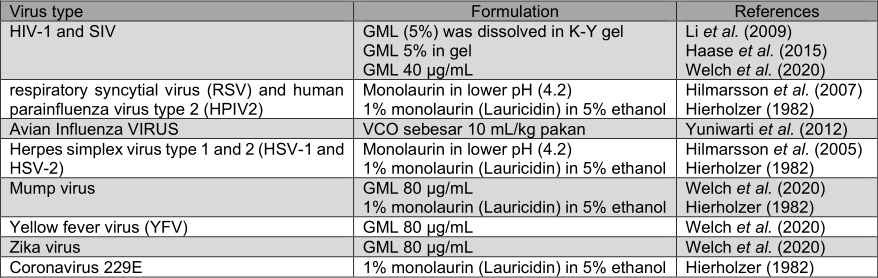
Monolaurin can inhibit various types of viruses. Some antiviral monolaurin studies are listed in Table 1.
Table 1. The role of monolaurin (GML) as an antiviral agent, after Rynnye Lyan Resources 2020
In a research from Jackman et al. (2020), the antiviral activities of selected MCFA, namely caprylic, capric, and lauric acids and glycerol monolaurate (GML), to inhibit ASFv in liquid and feed conditions, were investigated and suitable compounds and inclusion rates were identified that might be useful for mitigating ASFv in feed environments (Figure 1).
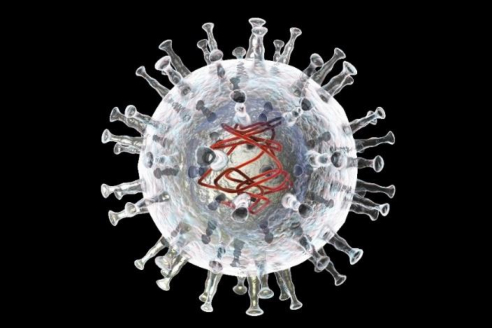
Figure 1: African swine fever virus, 3D illustration - DNA enveloped virus
Antiviral assays showed that among all the tested treatments to inhibit ASFv, GML was more potent than MCFA since it worked at a lower concentration and inhibited ASFv due to a direct virucidal activity along with one or more other antiviral mechanisms (Figure 2). Dose-dependent feed experiments further showed that sufficient GML-doses can significantly reduce ASFv infectivity in feed in a linear manner in periods as short as 30 min, as determined by infectious viral-titer measurements. Enzyme-linked immunosorbent assay (ELISA) experiments revealed that GML treatment also hinders antibody recognition of the membrane-associated ASFv p72 structural protein, which likely relates to protein conformational changes arising from viral membrane disruption.
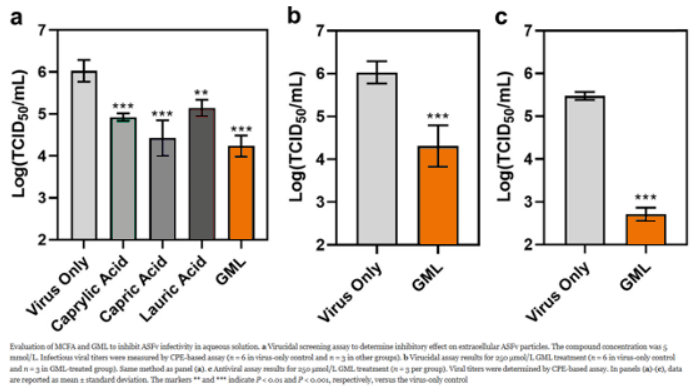
Figure 2: Anti-viral impact of MCFA and GML against ASFv (after Jackman et al., 2020)
These findings indicate that GML inhibits ASFv in liquid conditions and that GML is also able to reduce ASFv infectivity in feed, which may help to curb disease transmission.
The information on antiviral effects of organic acids to date, and formic acid in particular, is limited. It has however been found that formic acid is effective in inactivating enveloped viruses such as ASFv on fomites such as equipment (Juszkiewicz et al., 2019). Furthermore, using formic acid in high-risk feed materials, such as animal by-products, has been shown to inactivate enveloped viruses within 24 hours (Vinnerås et al., 2012).
Though, it had been mentioned before that the virucidal activity of monolaurin is enhanced under acidic conditions (Hilmarsson et al., 2007). As such the agglomerate of diformate and monolaurate (Formi 3G) will have a synergistic impact on reducing viruses – and can therefore be a potential additive to curb ASF in the swine production chain.
Conclusion
The activity profiles for many viruses have been determined, showing that medium-chain saturated fatty acids and monoglycerides thereof are generally most active. With their bactericidal effect against Gram positive bacteria mainly and their impact against enveloped viruses, monoglycerides are a valuable tool for sustainable healthcare in the post-AGP era. Their combination with an organic acid is preferred because of the effect of organic acids against Gram negative bacteria, and enhanced antiviral activity of monoglycerides at the conditions with lower pH. Formi 3G is therefore the product of choice when it comes to a holistic anti-bacterial approach in swine nutrition, with beneficial anti-viral effects at the same time.
For more of the article, please click here.
Article made possible through the contribution of Dr. S. Petrović, Dr. C. Lückstädt and ADDCON, Bitterfeld – Germany