
Mycotoxin survey for feed and feed ingredients in Asia Pacific
Mycotoxins are secondary metabolites produced by toxigenic fungi, which result in mycotoxicosis when ingested, affecting animals' health adversely. The prevalence of mycotoxin contaminations in feed and agricultural commodities may consequently lead to economic losses and pose a perpetual challenge in the feed industry. Hence, it is imperative to incorporate mycotoxin testing of feed and feed commodities as part of the mycotoxin risk management program, so that the effects of mycotoxins on animals can be mitigated.
In our survey, two main methodologies were adopted. Firstly, the conventional method using High-Performance Liquid Chromatography (HPLC) is employed for complex matrices, which involves the use of an immunoaffinity column for clean-up and thus minimizes the interferences prior to injection. Secondly, a lateral flow test device which utilizes lateral flow immunoassay technology was also used (Figure 1).
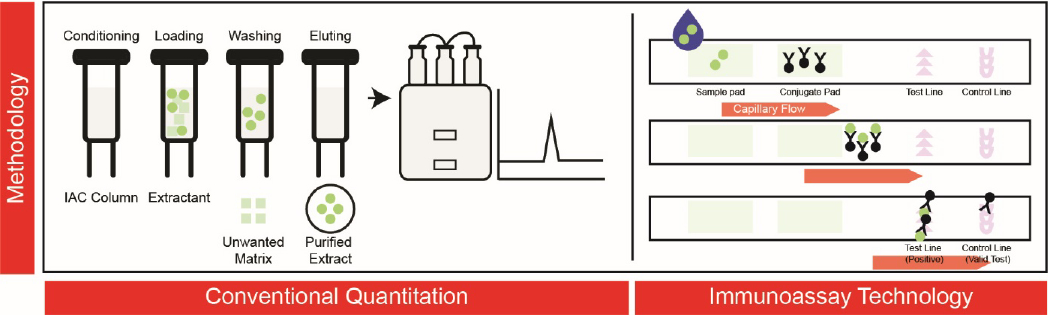
Figure 1. Schematic diagram of conventional HPLC (Left) and lateral flow immunoassay method (Right)
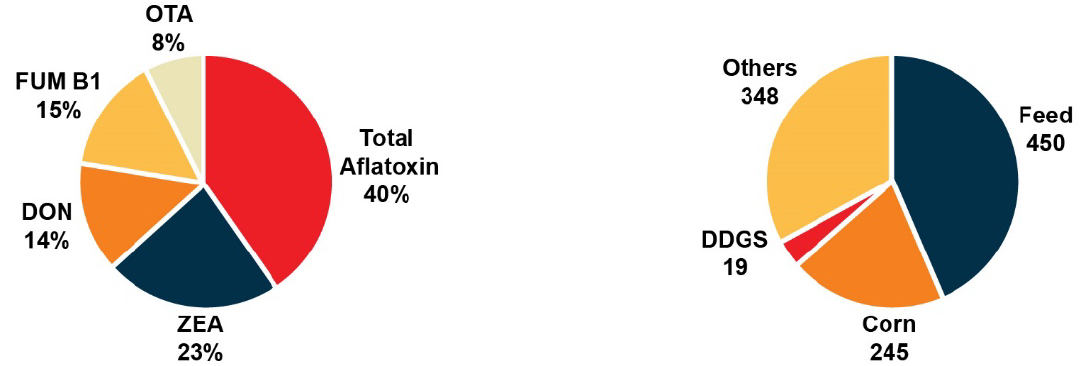
Figures 2 and 3. Mycotoxin analysis conducted, and the total number of samples analyzed (Left to Right)
High occurrences of mycotoxins in feeds and agricultural commodities were observed where at least 70% were contaminated with the Afla, ZEA and FUM (Table 1). The highest level of contamination in the samples was FUM, with an average concentration of 1,703 ppb.
Table 1. Mycotoxin contamination in all samples received in Asia from April 2016 to August 2019

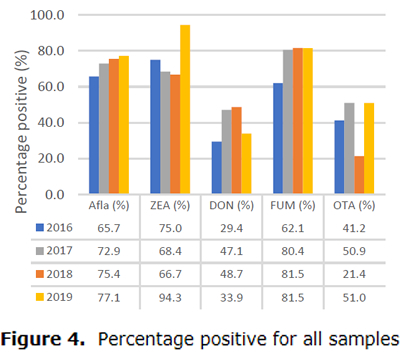 Throughout the 3 year study, it is revealed that there is a significant shift in mycotoxin contamination to more of Fusarium sp. toxins in both feed and commodities. It is profoundly influenced by the effects of climate change, bringing mycotoxin contaminations to preharvest crops. The ensuing increase in occurrences for ZEA, DON and FUM are seen in this study (Figure 4). In addition, high occurrence of Afla and OTA in samples remains a concern, as it is predominantly attributed to the tropical (and subtropical) climate and post-harvest storage conditions in Asia. Under these conditions, mold activities with these mycotoxin contaminations are encouraged (Figure 4).
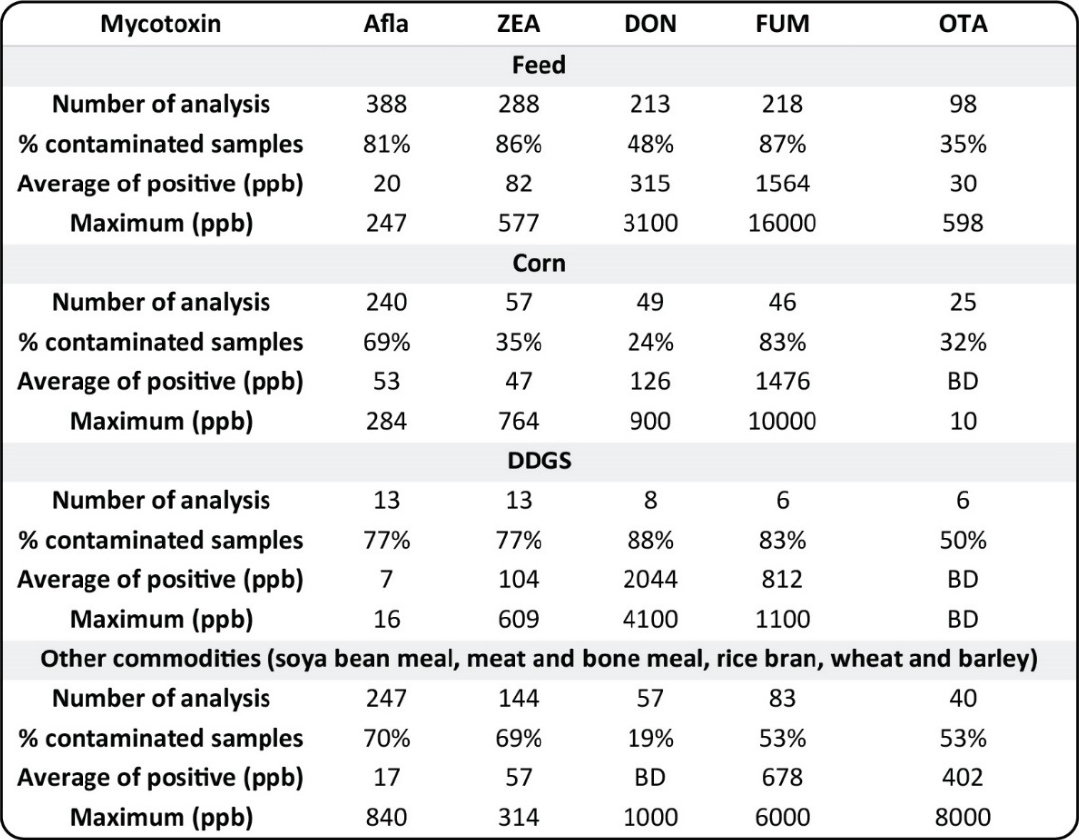
Note: BD: Below Detection Limit. The limits of quantification (LOQ) for Afla <3ppb, DON <250ppb, ZEA <25ppb, FUM <250ppb and OTA <10ppb
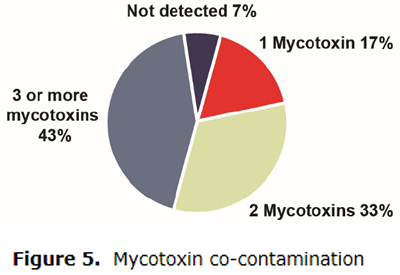 It is noteworthy to mention that the existing legislations or recommendations only consider a single mycotoxin exposure data. They do not address the concerns arising from mycotoxin co-contamination. From the samples received across Asia, 76% of them were contaminated with more than one mycotoxin (Figure 5). The co-contamination of mycotoxins is likely to result in synergistic effects where the adverse impacts of mycotoxins are magnified. Synergism occurs when the combined impacts of the mycotoxins are greater than the additive impacts of the mycotoxins.
In general, prevention methods employed during crop growth, harvesting, and storage can only decrease the potential risk of mycotoxin contamination to a certain degree. Therefore, detoxification procedures after harvest are a key area of focus. The elimination of mycotoxins in grains and feed occurs via three methods: physical, chemical, and biological processes in the grains, in the feed, and inside the bodies of animals.
Adsorbent materials are commonly used in feed as additives to counteract mycotoxins by binding them inside the animals, which then excrete them in feces. Among the major mycotoxins, Afla has a polar functional group with a planar structure that is well suited for adsorption. Also, OTA and FUM can be categorized as polar mycotoxins and both at pH 3.0 and pH 7.0 levels, the excellent binding efficacy against them has been well-documented. Mycotoxin Risk Management tools, which consist of analysis, diagnosis and detoxification, are available to mitigate the negative impacts of mycotoxins on the animals' health and performance.
For more of the article, please click here.
Article made possible through the contribution of Hui Ru Tay, Agnes Thng, David Tey and Kemin Animal Nutrition and Health, Asia Pacific